Perú
|
|
|
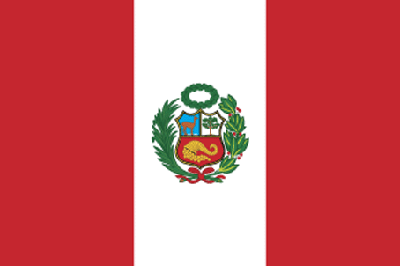

NAME: República del
Perú / Piruw (Quechua) / Piruw (Aymara)
NAME ETYMOLOGY: Popular etymology: "piru" in Quechua jeans
"What?"; The conquistadors said, in Spanish, "What's the name of
this place?", and the local Incas replied "Piru?"; Scholarly
etymology: "birú", name of chieftan in Panamá who said gold was to be
found farther south of Panamá.
POPULATION: 27,900,000 (1997); 28,700,000 (2007); 30,400,000 (2014)
ETHNIC GROUPS: Quechua and Aymará (45%); Mestizo (37%); white (15%);
Asian (2%); black (1%)
CAPITAL: Lima
(8,900,000–2014)
Principal
cities:
LANGUAGES: Quechua and Spanish (both official); Aymará
(unofficial)
RELIGION: Roman Catholic (81%);
Inca (9%); Protestant (5%)
LIFE EXPECTANCY: Men (68); women (72)
LITERACY: 88%
GOVERNMENT: Democratic republic
MILITARY: 115,000
active troops
ECONOMY: fishing,
cocaine, mining, cotton, sugar
MONEY: Nuevo
sol (3.4 = $1.00 US; 2006)
GEOGRAPHY: Pacific coast; arid coastal stip;
FACT: Perú is the world’s largest coca
leaf producer.
INTERNET CODE: .pe
KILLED BY SENDERO LUMINOSO
(1980-97): 20,000
HISTORY:
5000
BCE Evidence of first human
settlements in Perú: cultivation of beans, cotton, gourds; use of weapons;
construction of middens
4000-400
BCE Titicaca culture around Lake
Titicaca in Bolivia and SE Perú.
3200
BCE People on Perú's north
coast begin large-scale settlements.
1800-400
BCE Chavín culture
1800
BCE -1400 Many pre-Inca Andean
civilizations.
400
BCE-700 CE
400
BCE-800 CE Nazca culture.
100
BCE – 800 CE Mochica culture (the
800 – 1100 Huari culture.
1100 – 1400 Cajamarca, Chimu, and Ica cultures.
1200 Manco
Cápac organizes the kernel of Inca culture.
1400
(ca.) Kingdom of Chancas
(west of
1438
– 1533 Domination
by Incas with capital at Kuskum (El Cuzco). Viracocha and his son Túpac Inca
Yupanqui (1471-1493).
1450
1471 Túpac Inca's son, Huayna
Cápac (1464-1527) expanded the empire to its greatest size and power. The
empire covered 1,400 miles of the Pacific coast and into the
1513 Vasco Núñez de Balboa and
Francisco Pizarro cross the Isthmus of Panama, thus "discovering" the
Pacific Ocean for
1516 The future Inca emperor
Manco Inca is born.
1519-1521 Francisco Pizarro is involved in the
conquest of the Aztecs under Hernán Cortés.
1524-1525 Francisco Pizarro's first voyage
south from Panamá along the
1526-1527 Pizarro makes second voyage south
from Panamá, this time making his first contact with the northern end of the
Inca empire. Francisco's brothers Hernando, Juan, and Gonzalo accompany
Francisco, who was the oldest (and a half-) brother. Hernando
1527 Huayna Cápac died of
smallpox, which began spreading like a plague throughout the
1527-1531 Civil war between factions led by
the warring half-brothers Huayna Cápac and Atahualpa. The war ended in a battle
near Cuzco in which Huayna Cápac was defeated, captured, and slaughtered almost
all of Huayna Cápac's wives and family.
1532-1533 Incas conquered by Francisco Pizarro
(1475-1541) with 168 conquistadores
on Pizarro's third voyage south from Panamá.
1533 Pizarro captures
Atahualpa in Cajamarca, where Pizarro slaughters most of the Incas' nobility
and some of the Incas' generals. For the dramatic, first-hand description of
the massacre at Cajamarca, see the online version of the "Letter from Hernando Pizarro to the Royal Audience of Santo
Domingo, in Reports on the Discovery of Peru, Clements R. Markham, tr.
and ed. (London: Hakluyt Society, 1872), pp. 113-127, at this URL: http://www.shsu.edu/~his_ncp/Pizarro.html.
1533 Atahuallpa is executed
and Cuzco is conquered. Pizarro makes Manco Inca the puppet emperor.
1533-1541 Pizarro distributes encomiendas.
1535
1536 Manco Cápac leads a failed
Inca rebellion against Spanish. Gonzalo Pizarro steals Manco Inca's wife, Cura
Ocllo. Manco Inca starts a rebellion; he lays siege to
1537 Diego de Almagro returns
from
1538 Pizarro defeats Almagro
and has Almagro executed.
1539 Gonzalo Pizarro captures
Vilcabamba. Manco Inca escapes, while Francisco Pizarro executes Manco's wife.
1539-1616 Inca Garcilaso de la Vega, son of Inca princess and
conquistador; historian.
1541 Pizarro assassinated by
his conquistadors who favored Almagro.
1542 Name of Virreinato del Perú given to the region.
1544 The Spaniards murder
Manco Inca; meanwhile Gonzalo Pizarro rebels against
1551 The University of San
Marcos (now the Universidad Nacional Mayor de San Marcos), one of Perú’s two
most prestigious universities, was founded in Lima. It is known as the “dean”
of Latin American universities, because it was founded four months before the
University of Mexico. The Peruvian university that is also one of the othere top
two universities in the country is the Pontificia Universidad Católica del
Perú, was founded in Lima in 1917. The Peru’s great late twentieth and
twenty-first century novelist and writer, winner of the Nobel Prize for
Literature, graduate from San Marcos.
1555 Viceroyalty of El Perú
actually begun; Andrés Hurtado de Mendoza, first viceroy
1557-1560 The new Inca emperor, Sayri-Tupac
leaves Vilcabamba and relocates his capital near
1560-1571 Titu Cusi becomes the new Inca
emperor, and he locates his capital again in Vilcabamba, 100 miles east of
1571 Tupac Amaru Inca is the last emperor of Incas.
1572 The Viceroy of
1588 Bartolomé Álvarez, a
Dominican padre doctrinario (priest who taught Catholic dogma and the
Catachism), in the southern Peruvian diocese of Charcas, wrote a treatise to
king Felipe II of Spain entitled De las costumbre y conversación de los indios
del Perú; Memorial a Felipe II (edited in Madrid in 1998 by Ediciones
Polifemo). In this book Álvarez says that the native Peruvians were using their
second language, Spanish, not to teach Catholicism but rather to conduct legal
cases against the Crown. [1]
1604 El Inca Garcilaso de la
Vega publishes: Comentarios reales.
1652-1697 Juan del Valle Caviedes, satyric
poet; his Diente del Parnaso was
published posthumously.
1740 Nueva
Granada (Colombia and Venezuela) separated from Viceroyalty of Perú.
1742-1780 Tupac Amaru (José Gabriel
Condorcanqui titled Marqués de Oropesa), descendant of Incan Tupac Amaru
executed in 1571), captured and executed in 1780 by colonial royalist army.
1776 Viceroyalty of
1780 Tupac Amaru II leads
unsuccessful indigenous rebellion.
1820 José de San Martín
(Argentinian patriot military hero), moves his forces north from Chile with aid
from Lord Cochrane’s English navy.
San
Martín delays march on
1821 July 28: José de San Martín declares independence of
Perú.
Spanish
viceroy moves all royalist forces to northern Perú.
San
Martín needs help from Simón Bolívar.
Cochrane’s
navy deserts and San Martín’s forces are unruly.
Country
named "República del Perú"
1822 San Martín meets Bolívar
in
San
Martín withdraws humbly leaving field to Bolívar; San Martín’s wife dies; he
returns to Europe never returning to
1822-1826 Bolívar takes over independence war
seeing need to destroy last royalist forces; Bolívar rules Perú as absolute
dictador.
1824 Bolívar
defeates royalist forces in battle of Junín
(December
9, 1824) Bolívar’s forces win final battle against royalists at Ayacucho, thus
ending Spanish colonial presence in mainland American continent.
1825 Bolívar
goes to
1833-1919 Ricardo
1872-1876 Manuel Prado, first civilian
president
1879-1883 War of the Pacific between Perú and
1892-1938 César Vallejo, poet:
1895-1930 José Carlos Mariátegui, leftist
philosopher, journalist, and theorist.
1911-1969 José María Arguedas, magical realist
novelist.
1911 Hiram Bingham (
1922 Trilce, by César Vallejo, vanguardist poetry
1923 APRA
(Alianza Popular Revolucionaria Americana) created by Víctor Raúl Haya de la
Torre
1925-1930 Publication of Amauta by Vallejo and Maríategui: vanguardist and Marxist thought
and literature
1936-1939 Gen. Oscar Benavides, dictator
1936-present Mario Vargas Llosa, novelist of
Generación del Boom and magical realism
1939 Poemas humanos, poems published by César Vallejo
1948-1956 Gen. Manuel Odría, dictator
1962 La ciudad y los perros, by Vargas Llosa, initiates Perú in
Generación del Boom
1963 Fernando
Belaúnde Terry, president for Acción Popular party
1968 Military
coup; Gen. Juan Velasco Alvarado leads leftist military junta (1968-80)
1971 Gustavo
Gutiérrez publishes: Teología de la
liberación: perspectivas
1975 Military coup against
Velasco Alvarado by Gen. Francisco Morales Bermúdez
1980 Elections: Belaúnde Terry
president
Guerrilla
war by Sendero Luminoso begins
1985 Alan García, elected
president for APRA
1987 Mario Vargas Llosa leads
civic resistance to APRA's plan to nationalize the banks
1990 Presidential election
campaign between Vargas Llosa and Alberto Fujimori; Fujimori wins, June, 1990
June:
Fujimori dissolved congress, suspended most of constitution, and installed
press censorship, all in the name of fighting Sendero Luminoso’s terrorism
Sept:
Abimael Guzmán, leader of Sendero Luminoso, captured and sentenced to life in
prison.
The
city of Cuzco (Cusco), adopts as its official spelling: Q’osq’o, thus intending to represent a more Quechuan spelling of
the city’s name.
1994 Vargas Llosa becomes
Spanish citizen and wins
1995 Fujimori reelected
1996 Dec: Tupac Amaro leftist
revolutionaries (not Senderistas) took hostages in home of Japanese embassador
1997 March: army frees
hostages in embassador’s house and kills all guerrillas in the home; general
international praise for anti-terrorist success
2000 Fujimori fled to Japan in 2000 to
avoid arrest due to various scandals and accusations of illegal actions. The
Congress refused to accept his offer to resign the presidency; instead they
impeached and convicted him on many charges. He was extradited to Perú in 2007,
when he was convicted for illegal arrests; later he was convicted of human
rights violations, killings, kidnappings, death squads, murder, embezzlement.
He was sentenced to 25 years in prison.
2001 Alejandro Toledo Manrique
elected president; the statue of Pizarro is removed from the Plaza de Armas in
Lima due to campaigning by his wife, Eliane Karp.
2006 Alan García Pérez elected
president
2007
2011 June 6: runoff election
for President between Ollanta Humala (Gana Perú Party) and Keiko Fujimori
(Fuerza Party; daughter of Alberto Fujimori: see 1990 and 2000); Ollanta Humala
won the runoff. For an eloquent essay by a Peruvian novelist in support of
Humala, see the translation of: => “Perú: robar lo justo.”
2011-2016 Ollanta Humala, president of the
Republic of Perú. In political terms, Humala is center-left.
2016-2021 Pedro Pablo Kuzcynski Godard (b.
1938), centrist (or conservative-liberal) technocrat (economist), elected
president, from the new Peruvian political party, Peruanos por el Kambio.
GOVERNMENT: Federal Republic with parliamentary democracy since
1980 when Fernando Belaúnde Terry
replaced military dictatorship (1968-80); president elected every five years;
member of U.N., Nonaligned Movement, and Group of Eight (S. American countries)
PRESIDENT:
Alan García (until 2011)
Political
figures:
Alán García Pérez, leader
of APRA (Alianza Popular Revolucionaria Americana) born 1948, serving since
1985 as APRA leader
Guillermo Larco Cox
Ilda Urízar
Mercedes Cabanillas
Gustavo Saberbein
José Barsallo Burga
Abel Salinas
Luis Heysen
MAJOR
INTELLECTUALS:
Poetry:
Carlos Germán Belli (contemporary)
César Vallejo (1888-1938),
Vanguardism
Los heraldos negros (1922)
Poemas humanos (1927)
España, aparta de mí este cáliz (1937)
Novel: José María Arguedas: Los ríos profundos (1962)
Novel and Essay:
Mario
Vargas Llosa (born 1936)
La ciudad y los perros (1962-63)
La casa verde (1965)
Los cachorros (1967)
Historia de un deicidio (1971)
La tía Julia y el escribidor (1977)
Conversación en la Catedral (1969)
Pantaleón y las visitadoras (1973)
“Masacre
en los Andes” (1983)
La guerra del fin del mundo (1983)
Historia de Mayta (1984)
¿Quién mató a Palomino Molero? (1986)
Elogio de la madrastra (1989)
El hablador
(1988)
Contra viento y marea (1990)
Desafíos a la libertad (1994)
Cinema: Armando Robles Godoy: The
Green Wall (1972)
Political essay: Víctor Haya de la Torre
Mariátegui
Liberation theology:
Sixto
Severo
Gustavo
Gutiérrez, Teología de la liberación:
perspectivas (1971)
POLITICAL
SITUATION:
severe
economic problems
cocaine
production and traffic
guerrilla
war waged since 1980 by Sendero Luminoso
lead by Abimael Guzmán Gutiérrez (now in prison); this guerrilla war is
contained